Wednesday, April 9, 2014

PERSONAL PHILOSOPHY

“Our greatest weakness lies in giving up. The most certain way to succeed is always to try just one more time.” – Thomas Alva Edison. “Giving up” is not a phrase that is part of my lexicon: it just doesn’t sit right with me. Whenever I see that phrase, I shudder. Whenever I hear someone say that phrase, I cringe. And whenever I feel like saying that phrase, I look at myself with pity, wondering how I could even think about going against something I so devoutly reject. My dad raised me to never run away from my problems, and instead, to confront them and look them in the eye. In other words, he told to never give up, and I have lived by that advice for my entire life. To me, there is no tangible or perceptible point in giving up – what are you going to get out of it other than remorse over the fact that you did not give it your all when you had the chance to? Looking back over the experiences in my life, I realized that you really only get one shot, and what you do to make the most out of this opportunity defines who you are. Giving up is the last resort for many people, but I am not one of those people anyway. Giving up is not even an option for me. If I get a challenge, I face it. If I have to go out of my comfort zone, I reach as far as I can out of it. Even when things seem impossible, I try my best to find a way around the obstacles present in front of me and traverse them in a way that paves a path of success for me. In short: I never give up.

There is always an easy way out. Paths that require very little effort and resolve all of your problems by simply making them disappear. I call these methods: quitting. And believe me, the second most-hated thing in my book after giving up is quitting. Many people consider these to be the same, but I think that there is a fine-line difference between the two. Although you may give up at times, you do not completely abandon something altogether if you give up – you still have a chance to come back and make things right. Quitting is running away from all of the problems you have, not sticking through with things to the very end for whatever unacceptable excuse that comes to mind. Before 2014, the FHS Varsity Tennis Team was considered a joke. Tennis itself was seen as a sport that one could do to get the credits he/she needed to graduate while putting little effort for two hours after school. Although I was Co-Captain of the team in 2012 and 2013, I wasn’t really someone who could enact change, being an underclassman and having another captain who was a junior and senior the two years respectively. But why was tennis seen such condescendingly? Because everyone on the team was willing to give up. They were willing to give up when they felt like it and quit as they pleased. This year, though, I decided to change the way that things worked on the team – instill the values of not giving up and not quitting, trying your best and giving it your all, into the team. And guess what? It worked! The team is much stronger now and day after day demonstrates the values of not giving up at work. To see that one saying that I lived by my whole life changed the way in which a whole group of students conducted themselves in a competitive environment is extremely self-satisfying, and it just goes to show that having the mentality that is ready to fight it out until then end goes such a long way.


“You only live once” (yolo) is a saying that has been crazily popularized in the past years, and through this repetition, it has lost its real meaning. The truth behind yolo, when looked at from a generalized perspective, is very real: you truly do only get one life to live, and what you do to make the most of it is what you are going to get out of it. Would you rather look back on your life knowing that you gave your 100% in everything that you did and that you never left anything hanging? That you never gave up? Never quit? Or do you want to look back in retrospect and shamefully regret all the times that you gave up or quit and realize that you lost so much because of it? Giving up, or even quitting for the matter, is not living your life to the fullest. And this is what goes against my most fundamental personal philosophy. You have to live your life to the greatest extent that you can, otherwise there is no point in living altogether. And the only way to achieve this, in my mind, is to never, ever give up. No matter how easy it seems. Just never give up. And as Tom Robbins said as Andy Dufresne in The Shawshank Redemption, “Get busy living. Or get busy dying.”

Saturday, March 22, 2014

FAMILY ∞ UNITY (Chapters 16-19, D*)

In The Grapes of Wrath by John Steinbeck, the concept of family/unity undergoes a relative amount change as the novel progresses. The readers are introduced to this idea through the Joads, a family migrating west from their home in Oklahoma because of the grieving circumstances of the Dust Bowl and the Great Depression. Family is initially presented extremely traditionally, but changes as the story moves ahead.

The father appears to be the leader of the family (the head, who makes all of the decisions). The person who holds the next position in the family is the wife, and after her, the children, who seem to hold little to no power for themselves. Clearly, this is the traditionalist view of the household, where the man is domineering over the wife and the children, but this view changes as the novel develops. Ma is shown to have more power than previously assumed, as shown in her challenge of Pa's authority, and consequent victory of this quarrel (168-169), and the description of her as the "citadel of the family" (74), acknowledging the fact that her strength and hard-will kept the family together, strong and united. Without Ma, the family would most likely fall apart, thus making her vital and essential to its continued cohesiveness.

The concept of family and unity, initially, only applied to exclusively to each family, not inclusively to include all families as part of one, big group. It was used to be thought that "family" referred to only one of the sort, and not to the surrounding ones, but as the Joads move west, they realize that the idea of "family" in fact encompasses more than just one, sole family. The Joads, for example, were initially fending for themselves only as they began their journey out west. But when they met the Wilsons, a family in need of assistance, the Joads took them in and aided them in their time of need. "Family" now had a different meaning, not to just the Joads, but also to the families that were traveling west around them:
In the evening a strange thing happened: the twenty families became one family, the children were the children of all. The loss of home became one loss, and the golden time in the West was one dream. (193)
The dreams and possessions that originally belonged to one family are now part of a big group of families that act as one unit. This is classified as "strange" because it was not used to be like this before – it was used to be every family for its own, with no relation to outside families that they had no connection with. However, the Joads are now realizing that families were merging into "one" big group – one cohesive pack in which families helped each other, moved with each other, and did everything with each other for everyone's advancement and in everyone's best interests. The dream to head out West was now "one dream" that was shared by all the families that were traveling together, with each and every one helping the other to reach this goal. The repetition of the word "one" stresses the fact that everything became communal in the society of families moving west – children, goals, losses, wins, advances, setbacks, etc. Anything and everything that happened to one family applied to the rest of the group, contrary to the earlier nature of each family being individual from the rest. Families were now working together to advance themselves and those around them, realizing that a joint effort was much more efficient and fruitful than a singular one.

Monday, March 17, 2014

I ... AM AN OKIE (Chapters 16-19, C)

The following poem is written from the perspective of an Okie, traveling west from his farm home in the Great Plains region. The poem captures the hatred that the Okies experienced from the native westerners (i.e. Californians), and their struggle to cope with this adversity. It explores both the feelings that the Okies had relative to this hatred as well as the actual remarks that westerners made about the Okies. The sources for these explorations are pages 205, 206, 213, 214, and 221 from John Steinbeck's The Grapes of Wrath.

I ... am an Okie
Tryin' to make a livin' in the ol' West
Goin' to the land o' California
I ... am an Okie
Comin' from Oklahoma
Bein' a true Okie
He ... is an Okie
Isn't liked by them deputy sheriffs
Bein' called a 'son-of-a-bitch'
She ... is an Okie
A scum
A bum
She ... is an Okie
Can't stay here on this land
Why? Because...
She ... is an Okie
Gettin' scared by them darn police officers
Bein' drivin' off of this restin' spot
I ... am an Okie
Not wanted in the west
Cannot go back to my home
I ... am an Okie
With nowhere to go
Hardships looks me in the face. Everywhere.
I ... am an Okie
I ain't human, like a gorilla. I don't know any better.
Why? Because...
I ... am an Okie

J-U-X-T-A-P-O-S-I-T-I-O-N (Chapters 11-15, F)

Juxtaposition, in the literary sense, is the literary device that is employed in order to highlight the contrast between two entities, allowing for a deeper understanding of both entities and their use in their respective places. Authors juxtapose people, concepts, places, ideas, or other abstract entities, usually to bring about the difference in the two and then compare them. In Chapter 12 of The Grapes of Wrath, John Steinbeck uses two powerful instances of juxtaposition to highlight the struggle of moving west and to bring about the harsh realities of this movement.

On their journey to west, the migrant farmers are posed with their first negative:
[California] ain't that big. The whole United States ain't that big. It ain't that big. It ain't big enough. There ain't room enough for you an' me, for your kind an' my kind, for rich and poor together all in one country, for thieves and honest men. For hunger and fat. Whyn't you go back where you come from? (120)
Here, there is an evident juxtaposition of good versus bad. For instance, "rich and poor" (people), "thieves and honest men", and "hung[ry] and fat" (people) are juxtaposed. The reason for this juxtaposition is to bring out the lack of humanity in the world that was evident at the time. Steinbeck places these contrasting entities next to each other to show that only one or the other can survive; there is no compromise that can be worked out in order to accommodate such different peoples. These contrasting groups cannot, according to this use of juxtaposition, possibly be placed together in one society, where they can cooperate and advance as one united group. Instead, this juxtaposition brings out the ongoing theme of the inhumanity of men to other men, as one group of people, overcome by greed, desire, and want, cannot live with another group that is so largely different than it.

Later on, the migrant farmers face a challenge to their motives to move west:
Where does the courage come from? Where does the terrible faith come from? (122) 
An analysis of the author's rhetoric used in this quote shows that there are two interrogative sentences in a row with similar structure. This suggests that the authenticity of the whole idea of "courage" to go west is being questioned. Courage here is juxtaposed with "terrible faith," implying that courage is not a good trait in this case, but actually a detrimental one. It is characterized as being a disastrous belief that people have faith in, but in the end lets them down, thus being "terrible." The use of juxtaposition in this quote is to primarily indicate the negative results of courage; although historically proven to be a worthy and glorified characteristic, the courage that one possesses to move west and leave all else behind is, in actuality, an adverse belief that leads to fruitless ends.

Wednesday, March 12, 2014

The 30's 66 (Chapters 11-15, B)

Route 66

Route 66 (Logo)
U.S. Route 66 – US 66 – Route 66 – Will Rogers Highway – the Main Street of America – the Mother Road. All these names describe one entity: the path that thousands of farmers took in order to reach the idyllic state of California. Starting (originally) at Chicago, Illinois, the Route ran through the states of Missouri, Kansas, Oklahoma (origin of the Joads), Texas, New Mexico, and Arizona, ending at Santa Monica, California, a total path length of 2,448 miles. The farmers that embarked on their journey west took this road to symbolize opportunity and hope, wanting to leave the devastating effects of the Great Depression (which left them in poverty) and the gigantic dust storms (during the Dust Bowl) that destroyed their farms behind. During its height in the 1930s, Route 66 was called the Main Street of America to show the numerous amount of people traveling along this road in search of a better life. It was also referred to as the Mother Road to express the affection farmers had for it – as it was their gateway to opportunity, to a new life.

The Historic Route 66 and its pathway.
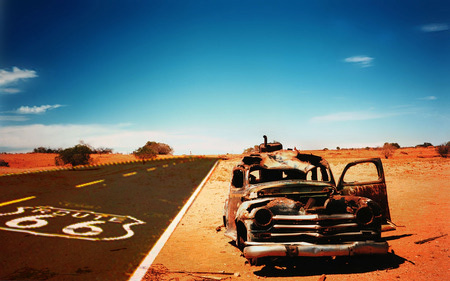
Despite the glorified name that Route 66 has, there was much adversity to be faced on the route. For example, cars (junky ones, mostly, called jalopies) constantly broke down on the route, causing delays in farmer migration and extra expenditures on their part. In Chapter 12 of The Grapes of Wrath, this harsh reality can be seen as people are trying to get their cars fixed, such as with the transaction of the tire for money. The picture below captures the essence of this disaster that often struck migrators.

Run-down jalopy on Route 66.
Sinclair Gas Station, Route 66.
Route 66 was also a highly profitable road – not for farmers, though. Small and large business owners with shops on Route 66 saw an increase in sales and profits as the number of people migrating west increased. Gas stations, especially, "struck gold" on the Mother Road, as the highly inefficient cars needed constant refueling of gasoline in order to keep trucking down the route. Mechanics, such as the one depicted in Chapter 12 of The Grapes of Wrath, also experienced an intense amount of monetary gain from the Mother Road, as the jalopies broken down very frequently, and their owners required the assistance of a mechanic in order to get fixed and continue on their journey. However, man's inhumanity and immorality to man is periodically viewed on the route as mechanics/business owners are overcome by greed and attempt to dupe the travelers into getting much less than their money's worth. Additionally, drive-in theatres also sprung up along Route 66, giving travelers enjoyment in their long trek towards opportunity. Lastly, towns also began to grow on the historic path, consisting of small rural communities and containing service stations, restaurants, motor courts, and other small shops of the sort – all profiting from the growing traffic on Route 66.


Friday, March 7, 2014

The Grapes of Wrath ~ The Bible (Chapters 1-10, I)

The Bible and The Grapes of Wrath share many similarities. Events that take place in the latter have allusions to those that occur in the former, and allow for deeper understanding of the text as a whole because there is another piece of literature that shares the same underlying events as the novel. These biblical allusions include, but are not limited to:
  • Jim Casy and Jesus Christ share the same initials of JC (in my opinion the most important and prominent)
  • Jesus Christ selected 12 ordinary disciples to spread his gospel to the world, similar to how Jim Casy and 12 other ordinary people (Tom Joad, Pa Joad, Ma Joad, Uncle John Joad, Al Joad, Noah Joad, Grampa Joad, Granma Joad, Winfield Joad, Ruthie Joad, Rose of Sharon Joad Rivers, Connie Rivers) are to embark on a journey west with Casy as a former preacher
  • Noah Joad represents the biblical version of Noah (of Noah's Ark)
  • Rose of Sharon Joad Rivers represents Rosasharn (Rose of Sharon - the flower), and both encapsulate the image of the young woman, as the rose represents youth
  • Uncle John Joad's killing of the pig (shoat) for a feast and Jim Casy's prediction of John's killing of a fatted calf alludes to Luke 15: 11-31, which states the biblical story of the killing of a fatted calf for a large feast
  • The serpent that Tom encounters represents the snake present in the Garden of Eden that deceives Adam and Eve
These connections that The Grapes of Wrath shares with the Bible help to further understand the importance and reasoning behind the naming of the characters, the manner in which events took place, the role/background of the characters, etc. For example, the fact that Jim Casy is a preacher, and that he represents Jesus Christ of the Bible, highlights that a preacher (former preacher, to be precise) will lead a group of people to the west (the "promised land" so to speak). The number of people totaling these 2 groups is 13 too – no coincidence, but purposely done in order to allude the novel to the Bible. The most interesting event that happened in Chapters 1-10 that alluded to the Bible and its events was the crossing of paths of the serpent and Tom Joad. This serpent is symbolic of the snake that Adam and Eve meet in the Garden of Eden. In this biblical story, the snake deceives Adam and Eve into eating forbidden fruit that led to remorse. Thus, based on the trend of biblical similarities, it can be predicted and foreshadowed that as California is the idyllic land like the Garden of Eden and contains "forbidden fruit," so to speak, such as oranges, the serpent that Tom encounters is tricking the Joads into coming to California, but will leave them in despair afterwards.The snake betrayed Adam and Even in the Bible, and is portrayed in such a manner that it seems to be betraying the Joads on their journey to the idyllic land as well.

Repetition (and Repetition) (Chapters 1-10, H*)

Goggled & Muzzled

Repetition is employed in literature in order to emphasize a particular idea through the use of a word/phrase multiple times. John Steinbeck uses repetition in various instances throughout The Grapes of Wrath, one of which being the description of a tractor driver about to clear out a tenant farmer's land:
"A twitch at the controls could swerve the cat', but the driver's hands could not twitch because the monster that built the tractor, the monster that sent the tractor out, had somehow got into the driver's hands, into his brain and muscle, had goggled him and muzzled him–goggled his mind, muzzled his speech, goggled his perception, muzzled his protest." (35)
The purpose of this repetition is to express the lack of control that some had over their own lives, as they were driven by the thoughts and wants of others. In this case, the tractor driver (most probably in need of money) does what he is told by the "monster," or the bank, to fulfill his job. However, he is evidently blinded by the wishes of the bank, and thus is "goggled" and "muzzled" to a point where he is uncontrollably unable to divert his actions from destroying the tenant farmers' land. The repeated use of "goggled" serves to highlight the fact that everything that this tractor driver 'sees' is covered up by the bank, allowing no room for personal decision. He is instead "programmed," so to speak, to complete a certain task for the bank and earn a monetary reward in the end as long as there are no complications and the job gets finished – which is what the tractor driver ultimately ends up doing, with the bank controlling every single one of his moves. "Goggl[ing]" the driver also demonstrates the grand arsenal of power that the bank has over the driver, as it is able to dictate every one of his actions and direct them in order to achieve the most profit out of his services. The repetition of "muzzled" also serves a similar purpose: it underscores the lack of voice the tractor driver has in his own actions. Any forms of communication or rebellion against his job are "muzzled," or put down, by the bank to prevent any obstacle from interfering between the bank and its goal of clearing up tenant farmers' land. "Muzzl[ing]" is an act that commonly associated with canines and is used as a restraining technique in order to quiet the animal and/or to prevent it from (possibly violent) outbursts. The fact that the driver is being "muzzled" allows a parallel to be drawn between the driver and a dog, highlighting that the driver is just a pawn in the game of capitalism as he is controlled by the bank, similar to how a dog is controlled by his master. This also brings about the great power that the bank has–as it has complete control of the driver and the driver can do nothing about it– and the fact that although the driver is committing these horrendous actions, he is just doing it at the will of the bank, and is just an intermediary. At the outset, the use of both "goggled" and "muzzled" demonstrates the lack of authority that workers had in their own lives due to their obligation to follow every one of their superior's orders and the obstinacy of capital, such as the bank, to get its job done no matter what.